

Learning how to spot fake remote job offers takes about five minutes per listing, and most fakes fail the very first check: a real employer never asks you to pay to start work. The other giveaways are just as easy to see once you know them, like a "recruiter" who texts you out of the blue or a job that shows up on a board but not on the company's own careers page.
Real remote jobs are out there, and they follow a pattern you can learn. The checks below come straight from the FTC and the FBI, so you're not guessing. And if you've already handed over your Social Security number or bank details to someone who now seems off, free credit monitoring from SoFi is an easy first move (more on that near the end).
The quick checklist
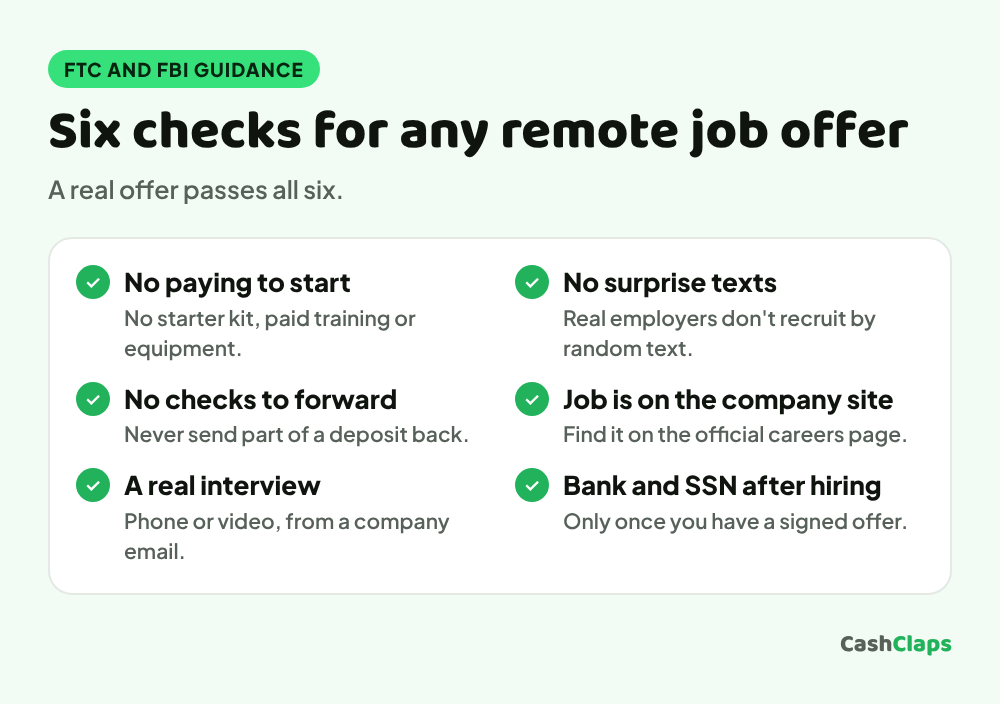
Run any offer through these six checks. If any of the first three is true, walk away.
- They want money from you before you start (a starter kit, paid training, a certification or equipment).
- They reached you first by text or through a chat app like WhatsApp.
- They're sending you a check and want part of it sent somewhere else.
- The job is missing from the company's own website.
- The "interview" is a chat in an app, with no video or phone call.
- They want your bank account or Social Security number before you have a signed offer.
That's it. Now the details behind each one.
They want you to pay before you get paid
This is the big one. The FTC's job scams guide puts it plainly: never pay for a job, and honest employers (the federal government included) won't ask you to. Starter kits, paid "training", certifications and job guarantees all fall under that rule.
The newer version is sneakier. The FTC calls them task scams: an app gives you simple "optimization" work like rating products or clicking through items, your earnings balance climbs, and then you're told to deposit your own money to reach the next level or cash out. There are no commissions. Only the people running the app make money.
These have grown fast. According to an FTC data spotlight, about 20,000 people reported task scams in the first half of 2024, compared with about 5,000 in all of 2023. Reported job scam losses went from $90 million in 2020 to $286 million in 2023, and crypto is now the payment method where people lose the most.
A recruiter texted you out of nowhere
Real employers don't open with a random text. In an April 30, 2026 consumer alert, the FTC described fake recruiters advertising remote roles like "online assessor", often listing the pay but not what the work actually is. Instead of sending a link, they ask you to reply "YES" or "INTERESTED" so they can start a conversation.
The FTC's advice is to ignore generic, unexpected job messages, whether they come by text or through WhatsApp and Telegram. If the company name sounds real, look up its careers page yourself and reach out from there.
The check shows up before the first day
A brand new employer mails or emails you a check, asks you to deposit it, and then wants you to send part of the money back, buy gift cards, or pay an "equipment vendor". That's a fake check, every time.
Here's why it works on people. Banks have to make deposited money available quickly, but the FTC notes it can take weeks for a bank to figure out the check was fake. By then the money you sent is gone, and you're the one paying the bank back. A "cleared" balance doesn't mean the check was good.
Reshipping jobs belong in the same pile. The FTC says receiving packages, repacking them and sending them on is never a real job.

Sign up for SoFi's free credit score monitoring as your first SoFi product and get $10 in SoFi rewards points, plus entries in SoFi's $50…
The job lives on a job board but not on the company's site
Back in 2020, the FBI's Internet Crime Complaint Center warned that criminals copy real company websites and post fake openings on popular job boards. One of its main tips: the posting shows up on the board but not on the company's own website.
So search the company name by itself, go to its official site, and find the careers page. If the role isn't there, email the company's HR address from that site and ask. The FTC also suggests searching the company or recruiter name with words like "review" or "complaint". (No hits doesn't prove it's real, but a page full of complaints tells you plenty.)
Check the email address too. The FBI flagged recruiters writing from free email accounts instead of the company's own domain, and "interviews" held in teleconference apps that use an email address in place of a phone number.
What real employers ask for, and when
A real employer will ask for your Social Security number and bank details, just later than a fake one. The FBI's advice is that legitimate companies ask for that information for payroll after they hire you. Never give a credit card number to an employer at all.
A normal order looks like this: an application, a phone or video interview with a person at a company email address, a written offer, and then onboarding paperwork (tax forms, direct deposit). If someone skips straight to the paperwork, slow down.
What to do if you already shared your info
Don't panic. Most of the cleanup is free, and you can do it tonight:
- Turn on credit monitoring so you see changes fast. SoFi's free credit score monitoring tracks your score and alerts you to changes. If you're new to SoFi, signing up through our listing also gets you a points bonus (the offer box on this page shows the current amount).
- Pull your full credit reports at AnnualCreditReport.com, which the FTC says is the only site authorized for free reports. You can check each of the three bureaus once a week for free.
- If you gave out your Social Security number, think about a credit freeze. The FTC's identity theft guide explains that a freeze stops anyone from opening new credit in your name, and you set it up with each of the three nationwide credit bureaus separately. A free one-year fraud alert is the lighter option, and you only need to contact one bureau.
- Report it at ReportFraud.ftc.gov, and use IdentityTheft.gov for a step-by-step recovery plan.
If you sent money, contact the bank, card company or app you paid with right away and ask whether they can reverse it.
Where to find real remote work
Start with sources that check listings or come straight from the employer. For government jobs, use USAJobs.gov, which is free to apply through. Our work from home page lists gigs we've looked into, and if you'd rather pay for a filtered board, we broke down what FlexJobs costs and who it suits.
Honestly, the habit that helps most is boring: open every offer in a new tab, find the company's own site, and check that the job is there. And set up free credit monitoring before you start sending out applications, so you'll know right away if your details ever end up where they shouldn't.
Frequently asked questions
How can you tell if a remote job offer is fake?
The fastest signs are a request for money before you start, an unexpected text or WhatsApp message from a recruiter, and a job that isn't listed on the company's own website. Any one of those is reason enough to stop.
Do real remote jobs ask for your Social Security number?
Yes, but only after you're hired, for payroll and tax forms. The FBI says legitimate companies ask for personal and bank details after hiring, not during the application.
Is it normal for a remote job to send you a check for equipment?
No. A new employer that sends a check and asks you to forward part of it to a vendor is running a fake check scheme, and the FTC says you'd be the one repaying the bank.
Where do I report a fake job offer?
Report it to the FTC at ReportFraud.ftc.gov. The FTC also suggests telling your state attorney general, and the FBI takes internet crime reports at ic3.gov.
Can a job interview happen over text or chat?
Real employers usually interview by phone or video with someone using a company email address. The FBI flagged interviews held in teleconference apps that use an email address instead of a phone number as a sign of a fake offer.
Sources (9)
- FTC: Job scams
- FTC: How to spot and avoid task scams
- FTC: That job offer text is probably a scam
- FTC Data Spotlight: Paying to get paid
- FTC: Fake check scams
- FBI IC3: Cyber criminals use fake job listings
- FTC: What to know about identity theft
- FTC: Free credit reports
- SoFi: Free credit score monitoring
Sign up for SoFi's free credit score monitoring as your first SoFi product and get $10 in SoFi rewards points, plus entries in SoFi's $50…