

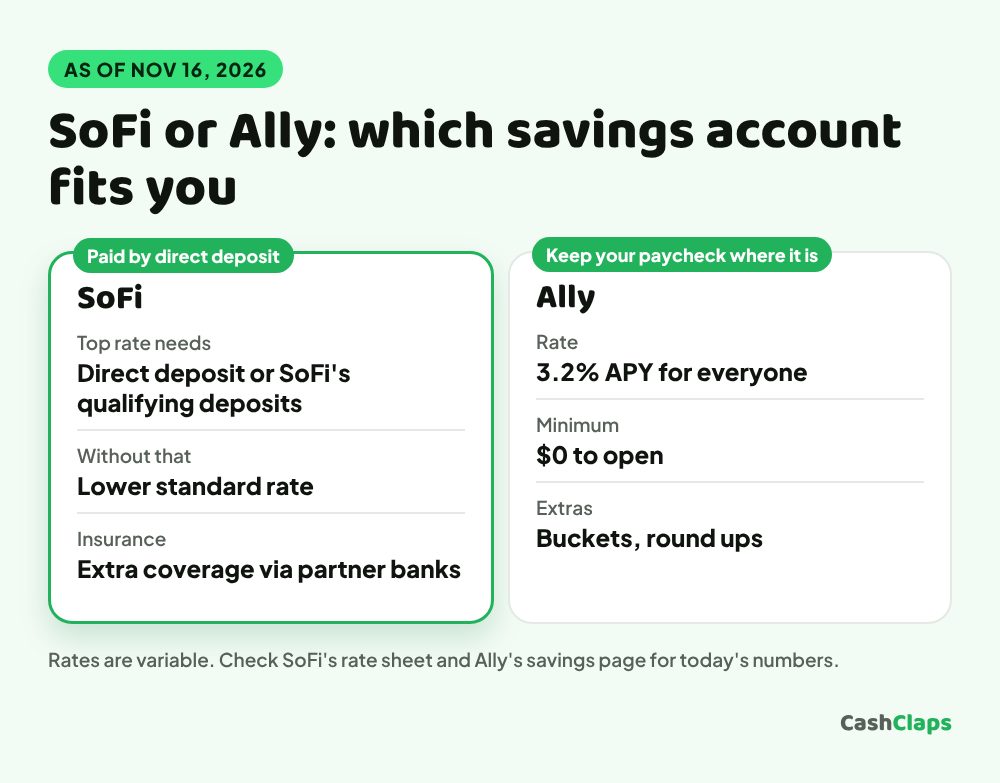
SoFi vs Ally savings is mostly a question about your paycheck. If your pay already lands by direct deposit and you're willing to move it, SoFi usually comes out ahead, because SoFi saves its higher savings rate for members who get direct deposit there. If you'd rather leave your paycheck where it is, Ally's savings account pays the same rate to everyone, 3.2% APY as of November 16, 2026, with no minimum balance.
We'd open SoFi first if you're paid by direct deposit. And if you want to try SoFi before moving any money, its free credit score monitoring is the easy first step: sign up through our SoFi offer as your first SoFi product and you get a rewards points bonus.
How SoFi's savings rate works
SoFi runs two rate levels on the same account. Members who have an Eligible Direct Deposit, or whose Qualifying Deposits reach the amount SoFi sets in its terms, earn the higher rate. Everyone else earns SoFi's standard rate, which is much lower.
SoFi asks partners like us not to quote its exact rates, since they change. So for today's numbers, open the SoFi Bank Rate Sheet. It's a short PDF, and the table you want is "Rates for Account Holders with Eligible Direct Deposit."
What counts as an Eligible Direct Deposit is pretty specific. It has to be recurring income from an employer, a payroll or benefits provider, or a government agency, sent by ACH. Payroll counts. So do pensions and Social Security. A Zelle transfer from your other bank doesn't, and neither does a Venmo payment or a one-time tax refund.
Good to know: SoFi suggests checking the APY Details page in the app once your first paycheck lands. If the higher rate isn't showing, you can call SoFi with your deposit details and they'll fix it.
What Ally pays, and who it suits
Ally's savings account pays 3.2% APY as of November 16, 2026. There's no direct deposit rule and no monthly maintenance fee, and you can open it with $0.
That's the whole appeal. You don't change anything about how you get paid. You open the account, move money in when you can, and it earns the posted rate whether you have $50 or $50,000 in there.
Ally's rate is variable, like every online savings rate, so it can move after you open the account.
SoFi vs Ally savings at a glance
| SoFi | Ally | |
|---|---|---|
| Rate | Depends on your deposits, see SoFi's rate sheet | 3.2% APY |
| To get the posted rate | Eligible Direct Deposit or SoFi's qualifying deposit amount, see SoFi's terms | Nothing extra |
| Minimum balance | None | None, $0 to open |
| Savings extras | Pairs with SoFi Checking | Buckets, Surprise Savings, round ups |
| FDIC coverage | Extra coverage through a program of partner banks, see SoFi's terms | Up to the legal limit |
Which pays more interest: SoFi or Ally?
For most people with a regular paycheck, SoFi's direct deposit rate is the one to compare against Ally's 3.2%. Look it up on SoFi's rate sheet and do the math on your own balance.
Here's a quick way to think about it. Say you keep $4,000 in savings. At 3.2% APY, Ally pays you roughly $128 over a year if the rate holds. Run the same $4,000 through SoFi's direct deposit rate and compare. If SoFi's number is higher and you're fine routing your paycheck there, SoFi wins.
Without direct deposit, the answer flips. SoFi's standard rate is a fraction of its top rate, so if you can't or won't move your pay, Ally is the better home for your savings. Honestly, that's the only reason we'd send someone with a regular paycheck to Ally first.

Sign up for SoFi's free credit score monitoring as your first SoFi product and get $10 in SoFi rewards points, plus entries in SoFi's $50…
SoFi also has a paid membership called SoFi Plus that comes with its own savings tier. The details are on the same rate sheet.
Does SoFi count Zelle or transfers?
No, not toward the direct deposit rule. But SoFi's second path helps here. Qualifying Deposits are much looser, and they count as long as they add up to the amount SoFi sets in its terms. SoFi's rate sheet lists these sources:
- ACH transfers from another bank
- Inbound wires
- Peer-to-peer transfers (Zelle, Venmo, PayPal, Wise)
- Check deposits
- Cash deposits
- Instant funding or push payments to your SoFi debit card
So a freelancer who gets paid through PayPal can still reach SoFi's higher rate, as long as enough money flows in to meet SoFi's qualifying amount. If your inflow falls short of that and none of it is payroll, Ally is simpler.
Ally's savings tools
Ally built its savings account around organizing money without opening extra accounts. Buckets let you split one balance into labeled goals (rent, car repair, holiday gifts) while the whole thing earns interest.
Then there are two automatic savers. Surprise Savings looks at your linked checking account, finds money it calls safe-to-save, and moves it over. Round ups rounds your Ally spending purchases to the next dollar and sweeps the change to savings once it reaches $5.
One limit: Ally allows 10 limited withdrawals and transfers per statement cycle from savings. Most people never come close, but if you move money out several times a week, use checking for that.
Is your money safe at SoFi and Ally?
Yes. Both are FDIC-insured banks. The FDIC's standard coverage is $250,000 per depositor, per ownership category, at each insured bank. Ally says its deposits are insured up to the maximum allowed by law.
SoFi goes further on paper. Through the SoFi Insured Deposit Program, it spreads your money across partner banks, so deposits may be insured well past the standard limit (SoFi lists the details in its terms). That matters only if you hold a lot more than $250,000 in one account, which most readers don't.
Should you open both?
Plenty of people do. A common setup is SoFi as the main account where the paycheck lands, with Ally as a separate spot for an emergency fund you'd rather not see every time you open your banking app. Ally charges no monthly maintenance fee on savings, and SoFi lists its own fees and terms on its savings account page.
If you're new to SoFi and want to start small, begin with the free credit score monitoring offer: it's a soft pull and pays a points bonus once it's set up. Then, once your next paycheck is due, decide whether to switch your direct deposit and open savings too. More easy starter bonuses like this are on our referral cash page, and our list of apps that pay a bonus from day one has a few more.
Frequently asked questions
Is SoFi or Ally better for savings?
SoFi is usually better if your paycheck can go there by direct deposit, since that's how you get its higher rate. Ally is better if you don't want to move your paycheck, because it pays 3.2% APY (as of November 16, 2026) with no conditions.
What APY does SoFi pay without direct deposit?
SoFi pays a lower standard rate to members without an Eligible Direct Deposit or enough Qualifying Deposits to meet its terms. The current number is on the SoFi Bank Rate Sheet.
Does Ally have a minimum balance for savings?
No. Ally's savings account has a $0 minimum opening deposit and no monthly maintenance fee.
How many withdrawals does Ally allow from savings?
Ally allows 10 limited withdrawals and transfers per statement cycle from its savings account.
Are SoFi and Ally FDIC insured?
Yes. Both are FDIC-insured banks, and SoFi's Insured Deposit Program can extend coverage past the standard limit across partner banks.
Sources (5)
Sign up for SoFi's free credit score monitoring as your first SoFi product and get $10 in SoFi rewards points, plus entries in SoFi's $50…