
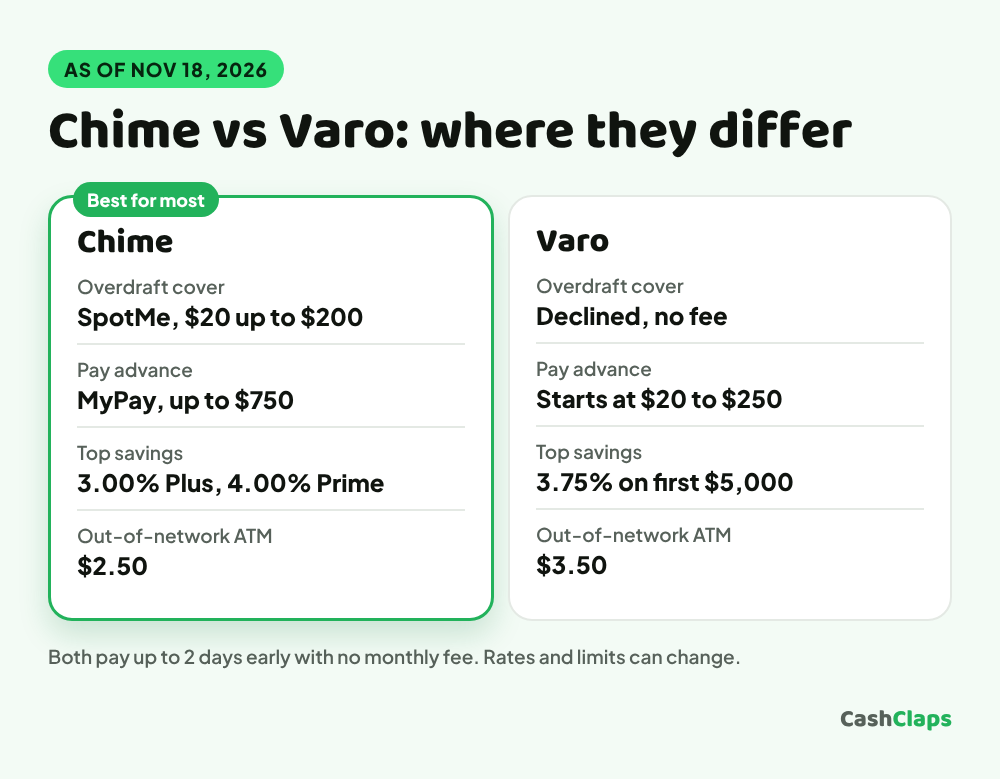
In the Chime vs Varo matchup, both apps can put your paycheck in your account up to 2 days early and neither charges a monthly fee. For most people Chime is the easier pick, because SpotMe covers you if a card purchase runs a little past zero and its fee-free ATM network is bigger. Varo makes more sense if you get $800 or more in direct deposits each month and want a higher savings rate on a smaller balance, or if you'd rather bank with a company that is itself a chartered bank.
Whichever one you open, it's a good moment to start watching your credit score too. Free credit score monitoring from SoFi takes a few minutes to set up and shows you when your score moves.
| Feature | Chime | Varo |
|---|---|---|
| Monthly fee | $0 | $0 |
| Early pay | Up to 2 days | Up to 2 days |
| Overdraft cover | SpotMe, $20 up to $200 | None (declined, no fee) |
| Pay advance | MyPay, up to $750 | Varo Advance, starts at $20 to $250 |
| Top savings rate | 3.00% (Plus), 4.00% (Prime) | Up to 3.75% on first $5,000 |
| Out-of-network ATM fee | $2.50 | $3.50 |
Chime vs Varo early pay: who's faster?
It's a tie. Chime says direct deposits can arrive up to 2 days early, and Varo's footnote says the same thing almost word for word: you get the money the day the bank receives your employer's payment file, which is typically up to 2 days before payday.
So the real speed depends on your employer. If payroll sends the file on Tuesday for a Friday payday, both apps show the money Tuesday or Wednesday. If payroll sends it Thursday night, you get it Thursday night with either one. Direct deposits only process on business days, so a Monday holiday can push things back a day.
Good to know: switching from one app to the other won't make an early payday any earlier. Pick based on everything else below.
Which one is an actual bank?
Varo is. Its accounts come from Varo Bank, N.A., Member FDIC, so the app and the bank are the same company.
Chime is a financial technology company. Its accounts are held at The Bancorp Bank, N.A. or Stride Bank, N.A., and those two banks carry the FDIC insurance. Chime says so plainly on its site.
For your money, both setups get standard FDIC coverage of up to $250,000 per depositor, per insured bank, per ownership category (the FDIC explains the rules here). The difference matters more for how the company runs than for whether your paycheck is protected.
What happens if you overdraw?
This is where Chime pulls ahead. With SpotMe, Chime covers debit card purchases, ATM withdrawals and cash-back when your balance dips below zero, and charges no fee or interest for it. Your limit starts at $20 and can grow to $200 depending on your account activity. You need $200 or more in qualifying direct deposits each month to use it.
SpotMe won't cover transfers, bill autopays or Pay Anyone payments. Card swipes only. After you repay, the app asks if you want to leave a tip. It's optional, and Chime says tipping has no effect on whether you can use SpotMe.
Varo takes a simpler route. If you don't have the money, the purchase is declined and you pay nothing. That's fine if you never cut it close. If you do, an embarrassing decline at the register is the cost.
Chime MyPay vs Varo Advance
Both apps will front you cash before payday, but they work differently.
Chime's MyPay lets you pull part of your pay early, with limits Chime advertises up to $750 (the smallest advance is $20). Free advances land within 24 hours. If you need it right away, instant delivery costs 3% of the advance, with a $2 minimum and a $5 maximum. There's no interest, but you need qualifying direct deposits of $200 or more coming into Chime. The MyPay page lists the exact rules.
Varo Advance is a small loan. If you're approved, your first limit falls somewhere from $20 to $250, and it can grow over time as you keep your direct deposit at Varo. Each advance carries a flat fee based on the amount, and you get up to 30 days to pay it back. Varo checks consumer reports when you apply, and paying late can hurt your credit, so read the fee table in the app before you borrow. The Varo Advance page has the details.
Honestly, for a $100 gap before Friday, MyPay's free option is hard to beat if you can wait a day. Varo's 30 days to repay helps more when payday is far off. We compare MyPay with other options in our guide to cash advance apps that work with Chime, and you'll find more in our cash advance section.
Savings rates compared
Sign up for SoFi's free credit score monitoring as your first SoFi product and get $10 in SoFi rewards points, plus entries in SoFi's $50…
Both start everyone at 1.00% APY. The higher tiers are where they split.
Chime pays 3.00% APY if you're a Chime Plus member, which takes a single direct deposit of $200 or more (or $400 total) in the past 34 days. Chime Prime members, who get $3,000 or more in direct deposits over 34 days, earn 4.00%. There's no balance cap and no minimum. Those rates were effective as of Oct 6, 2026, per Chime's savings page.
Varo pays up to 3.75% APY on your first $5,000, then 1.00% on anything above it. To qualify, you need $800 or more in direct deposits during the month and a positive balance in all your Varo accounts at month's end. That rate was accurate as of Oct 5, 2026, per Varo's savings page.
A quick example. If you earn $2,400 a month and keep $3,000 saved, Varo's 3.75% beats Chime Plus at 3.00%. If you earn $3,000 or more a month, Chime Prime's 4.00% wins, and it has no $5,000 cap. Both rates can change at any time. For two more savings accounts side by side, see our SoFi vs Ally savings comparison covers two more.
ATMs and cash
Chime has the bigger network: 47,000+ fee-free ATMs, including Allpoint and Visa Plus Alliance machines and the ones inside 7-Eleven stores. Out of network, Chime charges $2.50 per withdrawal, and the ATM owner may add its own fee.
Varo's fee-free ATMs are U.S. Allpoint machines. Anywhere else, Varo charges $3.50 per withdrawal, plus whatever the ATM owner adds. If you pull cash often, that $1 difference adds up fast.
Building credit with Chime or Varo
Both apps offer a secured credit card with no annual fee, no interest and no credit check, and both report to the three major credit bureaus.
The Chime Card replaced Chime's older Credit Builder card. You move money onto it, spend up to that amount, and Chime reports your monthly payments. You need a Chime Checking Account to apply.
The Varo Believe card works the same way. To apply, you need a Varo account with money in it and incoming deposits of $200 or more in the past 31 days.
On-time payments on either card can help your score over time. To see whether it's working, pair the card with SoFi's free credit monitoring and check in once a month.
Which one should you pick?
Go with Chime if you sometimes run low before payday, use ATMs a lot, or get less than $800 a month by direct deposit. SpotMe and the free MyPay option cover the tight weeks, and Chime Plus gets you 3.00% savings with just one $200 deposit.
Go with Varo if your direct deposits are $800 or more a month, you keep less than $5,000 in savings, and you never overdraw. You'll earn more on that balance, and you bank with the bank itself.
Either way, you can open the account in the app in a few minutes, then point your paycheck there and watch the next deposit show up early.
Frequently asked questions
Is Varo or Chime better for early direct deposit?
Neither is faster. Both release direct deposits the day they receive the payment file from your employer, which can be up to 2 days before payday.
Does Varo have something like Chime SpotMe?
No. Varo declines purchases when you don't have enough money and charges no overdraft fee. Varo Advance is a separate small loan you request.
Is Varo a real bank?
Yes. Varo's accounts come from Varo Bank, N.A., Member FDIC. Chime's accounts are held at The Bancorp Bank, N.A. or Stride Bank, N.A., which provide its FDIC insurance.
Can I have both Chime and Varo accounts?
Yes. They're separate companies with separate accounts. Just remember that the top savings and advance features each depend on direct deposits going to that app, so splitting your paycheck can drop you below a requirement.
Which has better savings interest, Chime or Varo?
It depends on your deposits. Varo pays up to 3.75% APY on the first $5,000 with $800 or more in monthly direct deposits. Chime pays 3.00% with one $200 deposit and 4.00% with $3,000 or more in 34 days.
Sources (12)
Sign up for SoFi's free credit score monitoring as your first SoFi product and get $10 in SoFi rewards points, plus entries in SoFi's $50…