

Yes, most survey sites sell your data, and the big ones say so in writing. If you're asking "do survey sites sell your data" before you sign up, the answer is in each site's privacy policy, and it's part of how they pay you: brands pay for opinions and shopper profiles, and the site passes some of that money back as points or cash. InboxDollars puts it plainly ("We may disclose or sell aggregate or individualized information about you"), and it also gives you clear opt-outs, which is why it's an easy first pick if you want to earn while keeping a say over your info.
We read the current member privacy policies for InboxDollars and Survey Junkie in November 2026. Here's what each one shares, who gets it, and the settings worth changing on day one.
Do survey sites sell your data, or only your answers?
Both. Your answers are the product, but the policies cover more than answers.
InboxDollars is run by Prodege, the company behind Swagbucks and MyPoints too, and one privacy policy covers all of those sites (last updated effective September 1, 2025). It lists four kinds of information it may disclose or sell: your personal info, how you use its sites, other websites and third-party services you visit, and your location.
Survey Junkie is owned by DISQO, a market research company. Its member policy says DISQO "sells and shares this information to our clients." The client list is long. It names market research agencies and ad agencies first, then retail, health product and telecom companies, plus social networks and data aggregators.
That's the honest answer to whether survey sites are safe: the legit ones are upfront about the trade. They tell you what they sell, in a document anyone can read before handing over an email address.
What "sell" means in a survey site's privacy policy
"Sell" is a legal word here, and it's broader than it sounds. California's privacy law gives you the right to opt out of both the "sale" of your info and its "sharing" for targeted ads across sites. That's why sites now carry a "Do Not Sell or Share My Personal Information" or "Your Privacy Choices" link in the footer, which California requires from businesses that sell or share personal info.
InboxDollars spells out its version. When its ad partners collect cookie IDs, IP addresses and browsing activity on its sites, it treats that as a sale or share, and you can opt out of it. Your email address and browsing activity used for targeted ads are covered by a second opt-out.
The rest is the profile you build: age, household, shopping habits and the answers you give. That's what makes a survey panel worth paying for. And it's why filling in your profile honestly gets you more surveys.
What InboxDollars and Survey Junkie say they share
Here's the short version of both policies, side by side.
| Detail | InboxDollars | Survey Junkie |
|---|---|---|
| Owner | Prodege | DISQO |
| Says it may sell data | Yes | Yes, to DISQO's clients |
| How to opt out of sale | Your Privacy Choices link or Consumer Rights Request page | Opt-out link in the policy (California) |
| How long data is kept | While your account is open, plus generally 3 years | As long as you use it, or as needed for business and legal reasons |
| Delete your account | Delete requests accepted from all users | Request form; unredeemed points are lost |
One more thing on Survey Junkie: its optional Surf to Earn apps (they used to be called SJ Pulse) share your browsing activity and location for extra points. You can skip them and still take surveys.
Is it safe to use survey sites that sell data?
For most people, yes, if you treat the sign-up like any free app. Give real answers on the profile questions that decide which surveys you get. Skip the ones you'd rather keep to yourself.
Sensitive details are the place to slow down. InboxDollars says that if you choose to give it sensitive info (things like religion or immigration status), you've agreed to its use, and you can send a request to limit how it's used. Because Florida and Texas law require it, the policy also prints the line "NOTICE: We may sell your sensitive personal data." Good to know: the simplest fix is to leave optional sensitive questions blank.

Sign up for SoFi's free credit score monitoring as your first SoFi product and get $10 in SoFi rewards points, plus entries in SoFi's $50…
Survey Junkie asks for your name, address, phone number, email, date of birth and gender at sign-up, and it may ask for a photo ID to verify who you are. That's normal for a site that pays real money, since it has to pay the right person. A site that asks for a sign-up fee or your bank login is a different story, and our guide on how to tell a real sign-up bonus from a fake one covers those.
How to stop survey sites selling your data
This takes about as long as making coffee.
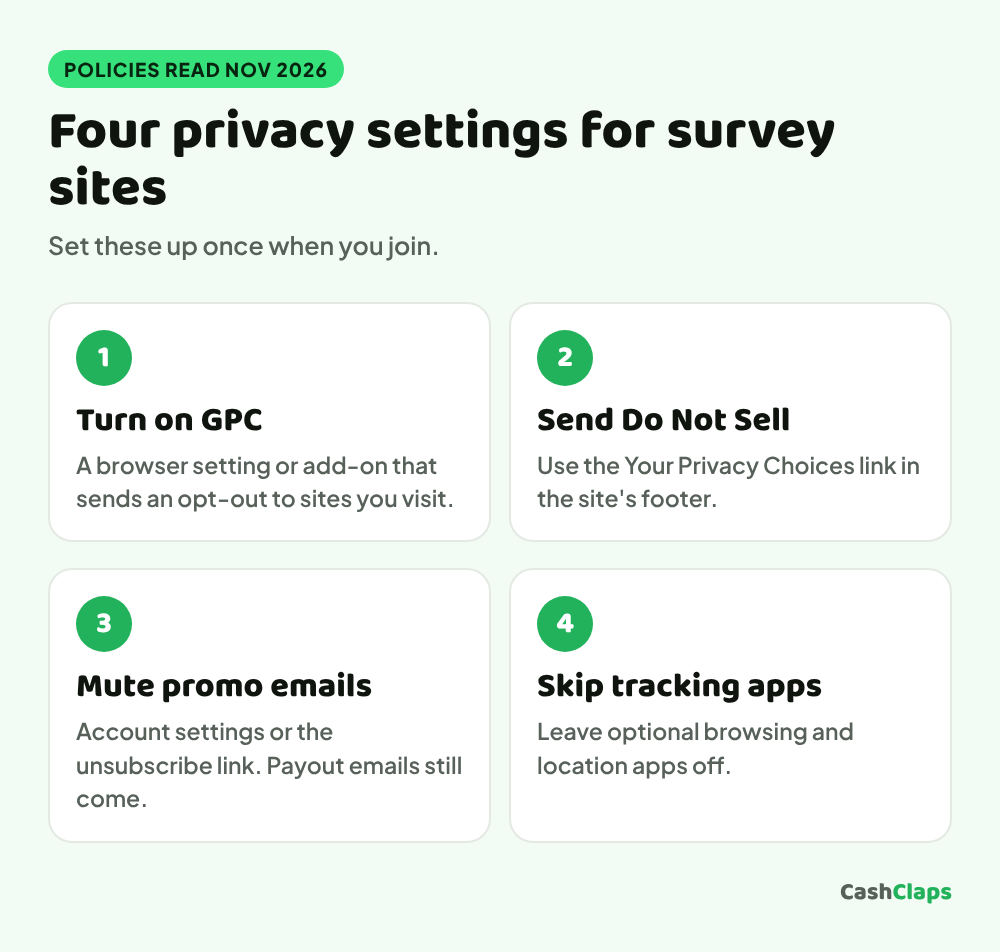
- Turn on Global Privacy Control (GPC) in your browser. Some browsers have it as a setting; others need an add-on. California's privacy agency says businesses must honor it as a valid opt-out of sale and sharing, and InboxDollars says it honors GPC for cookie-based sales in states that require it.
- Click "Your Privacy Choices" or "Do Not Sell or Share" in the site's footer and send the request. InboxDollars says opt-outs don't need an ID check unless it suspects fraud.
- Turn off marketing emails in your account settings, or use the unsubscribe link in any promo email. Account and payout emails keep coming, which is what you want.
- On Survey Junkie, leave the Surf to Earn apps off unless you're fine sharing browsing and location for the extra points.
GPC only applies to the browser where you switch it on, so set it on your phone too if that's where you take surveys. And InboxDollars notes that GPC can make it harder to credit some rewards you earn through offers. If a completed offer doesn't track, that's the likely reason, and it's worth checking your settings before you contact support.
What if you don't live in California?
You still have some rights, and they depend on your state. California's law gives residents six: to know what's collected, delete it, correct it, opt out of sale and sharing, limit sensitive data, and get equal treatment for using those rights (CalPrivacy has the full list).
InboxDollars' policy has extra notices for residents of 21 states, among them Texas and Virginia. For everyone else, it says it may consider requests at its discretion, and it accepts delete requests from all consumers.
Can you delete your data from a survey site?
Yes. Both sites take deletion requests. Cash out first, though.
On Survey Junkie, you send the request through its online form or customer service, and the policy is blunt about the result: the account can't be reinstated and any unredeemed points are gone. On InboxDollars, you use the Consumer Rights Request page. It may keep some records for legal and security reasons, and it may strip identifying details from data instead of deleting it. Our walkthrough of how an InboxDollars PayPal cash-out arrives shows how to get your balance out before you close anything.
The setup we'd use
If you want to earn from surveys and keep a say over your info, start with InboxDollars: sign up, turn on GPC, send the Do Not Sell request from the footer, and fill in the profile questions you're comfortable with. That's a five-minute setup, and then you can take surveys knowing exactly what the trade is. When you're ready to add a second site, check our paid surveys page for the survey offers we've reviewed.
Frequently asked questions
Do survey sites sell your email address?
Some use it for ads. InboxDollars lists your email address among the info you can opt out of sharing for targeted advertising, and you can turn off its marketing emails in account settings.
Does Survey Junkie sell your data?
Yes. Its member privacy policy says owner DISQO sells and shares the information it collects with its clients, including market research and ad agencies.
Will opting out stop me from earning on InboxDollars?
InboxDollars says it won't charge you or change your experience for using Global Privacy Control, though GPC may make it harder to credit some rewards from offers.
How long do survey sites keep your data?
InboxDollars says it generally keeps it while your account is open and for 3 years after it closes. Survey Junkie keeps it as long as you use the site or as needed for business and legal reasons.
Do I have privacy rights outside California?
It depends on your state. InboxDollars' policy covers residents of 21 states and accepts delete requests from everyone.
Sources (4)
Sign up for SoFi's free credit score monitoring as your first SoFi product and get $10 in SoFi rewards points, plus entries in SoFi's $50…