

What counts as a sign up bonus scam comes down to one simple test: if you have to send money, share a login or move someone else's cash to get the "bonus", it's fake. A real sign-up bonus goes the other way. The company pays you after you open an account and do something ordinary, like set up direct deposit or make a few purchases, and the rules are written down on its own website.
That's good news, because real bonuses are everywhere and most of them are easy to spot. Below are the six signs of a fake, what a real offer looks like next to them, and what to do if you already clicked. If you want a cheap safety net while you sign up for things, credit score monitoring from SoFi is a quick first step (more on that near the end).
What a real sign-up bonus looks like
A real bonus is paid by the company whose account you're opening. The money comes from that company's marketing budget, and it lands in your new account or app balance after you meet the terms.
Banks even have rules about how they advertise it. Under the federal Truth in Savings rules (Regulation DD, section 1030.8), a bank ad that states a bonus has to spell out, where it applies, the time requirement, the minimum balance needed and when the bonus will be paid. So a real bank bonus always has fine print you can read before you sign up.
Referral bonuses work the same way. A friend shares a link, you join through it, and the company pays one or both of you. Nobody asks you for money. That's the whole model, and it's why we list referral offers on our referral cash page.
Sign 1: you have to pay to get the bonus
Any "bonus" that asks you to pay a fee, a tax or a deposit to the person offering it is fake. The FTC's guide to prize and sweepstakes scams puts it in four words: "Real prizes are free." It lists "processing fees", "shipping and handling charges" and "taxes" as the usual excuses.
A real bank bonus can ask you to deposit money into your own new account. That's different. The money stays yours, in an account in your name, at a bank you can look up.
Sign 2: your balance grows, then they ask for a deposit to cash out
This one hides inside apps that look like gig work or rewards sites. The FTC describes it in its alert on task scams: you do simple tasks, your earnings climb, and you even get a small payout early on, "usually $5 to $20", to build trust. Then you're told to deposit your own money, usually in crypto, to get more tasks or withdraw. That deposit doesn't release anything, because the earnings were never real.
Real rewards apps work in reverse. You earn, you hit the minimum, and you cash out. We walked through what that looks like with InboxDollars in our PayPal cash-out guide.
Sign 3: "send $50, get $500 back"
Cash flipping is the oldest trick on payment apps. Someone in your DMs promises to multiply whatever you send. Cash App's own page on cash flip scams says the screenshots of big returns are fake and "the offer is the entire scam." Some flippers even send $20 back first so you trust them with a bigger amount.
Cash App's advice is short: don't send money to someone you've never done work for based on a promise to send more back.
Sign 4: someone pays you to open an account they control
"I'll give you $100 if you open a bank account and send me the login." Or "receive this money for me and keep a cut." It sounds like a bonus. It's actually money laundering, and you'd be the one on the hook.
The FBI's Internet Crime Complaint Center calls this being a money mule: anyone who moves money for someone else. Unsolicited requests to open a bank account are one of the recruiting methods it lists. Mules risk identity theft, damage to their credit and criminal penalties, even when they didn't know what was going on.

Sign up for SoFi's free credit score monitoring as your first SoFi product and get $10 in SoFi rewards points, plus entries in SoFi's $50…
A real bonus never needs anyone but you to touch your account.
Sign 5: a text says you already won a bonus
Messages like "Your $200 welcome bonus is waiting, tap to claim" are fishing for your login or card number. The FTC's phishing guide lists offers of "free stuff" and requests to confirm personal or financial information as classic signs.
If you do have an account with that company, open its app or type its web address yourself and look there. A bonus you really earned shows up inside your account.
Sign 6: a "bonus check" arrives and they want part of it back
A stranger mails a check, calls part of it your bonus, and asks you to forward the rest as gift cards or crypto. The FTC's fake check guide explains why it works. Banks have to make deposited funds available quickly, but fake checks can take weeks to be discovered. When the check bounces, you're the one paying the bank back.
How to check an offer in two minutes
Before you sign up for anything with a bonus attached, run through this:
- Find the offer on the company's own website or app, not just in a post or DM.
- Read the terms: what you have to do, by when, and when it pays.
- Make sure the only money you move goes into an account in your own name.
- Never share your login or a one-time code with anyone, including the person who referred you.
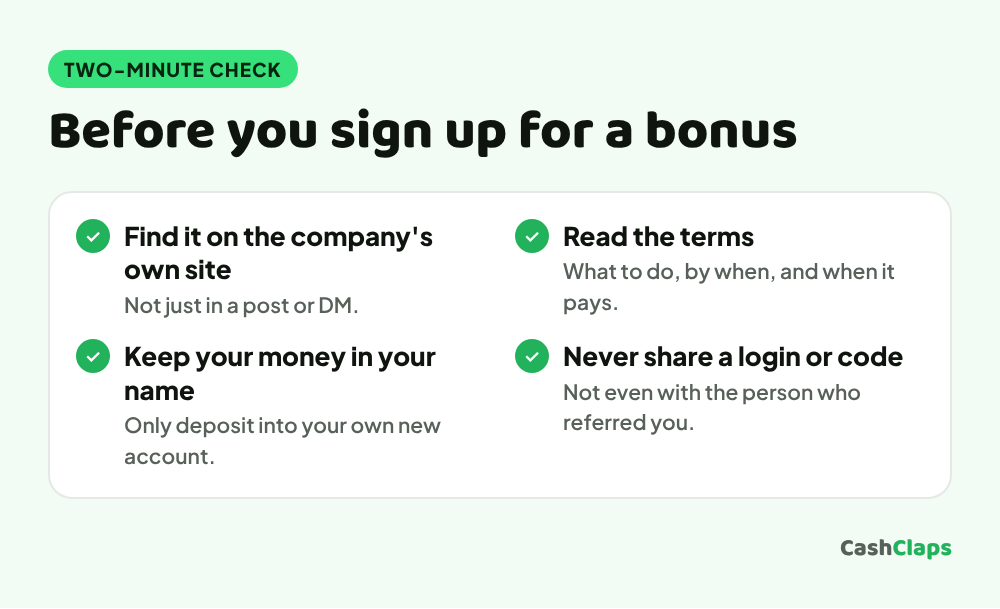
If an offer passes all four, it's almost certainly the normal kind. And honestly, those are the fun ones. Plenty of apps pay a real cash or points bonus just for signing up and doing one easy thing.
If you already paid or shared something
Don't beat yourself up. Move quickly instead:
- Call the bank or app you paid with and ask whether the payment can be stopped or reversed. Cash App says to report it inside the app and to save screenshots, receipts and $cashtags.
- If you shared your Social Security number or bank details, go to IdentityTheft.gov for a recovery plan.
- Report it at ReportFraud.ftc.gov. If someone had you move money, also report it to the FBI at ic3.gov and stop all contact.
- Turn on credit monitoring so a score change doesn't slip past you. SoFi's credit score monitoring shows your VantageScore based on TransUnion data, and new SoFi members who activate it get a points bonus (the offer box on this page shows the current amount).
That last one is also the easy move if you're about to try a few new bonuses. Set up monitoring first, then sign up with a clear head. If you're comparing gig offers too, our checklist for spotting fake remote job offers uses the same habits.
Frequently asked questions
Are sign-up bonuses legit?
Most are. A real sign-up bonus is paid by the company you join, after you meet terms posted on its own website. It's a fake when you're asked to pay, share a login or move someone else's money first.
Is it a scam if a bank bonus needs a deposit?
Not if the deposit goes into your own new account. Banks often ask for a direct deposit or a minimum balance, and federal rules require their bonus ads to state the time and balance requirements.
Why would a stranger pay me to open a bank account?
Usually to use your account to move stolen money. The FBI calls that being a money mule, and it can lead to identity theft, credit damage and criminal charges.
How do I know a referral link is real?
Open the company's own site or app and confirm the referral offer is listed there. A real referral link takes you to the company's official sign-up page and never asks you to pay the person who shared it.
Where do I report a fake bonus offer?
Report it to the FTC at ReportFraud.ftc.gov. Forward scam texts to 7726 (SPAM), and if you paid through an app, report it to that app too.
Sources (8)
- CFPB: Regulation DD, section 1030.8 (advertising)
- FTC: Fake prize, sweepstakes and lottery scams
- FTC: How to spot and avoid task scams
- Cash App: Cash flip scams
- FBI IC3: Money mules, a financial crisis
- FTC: How to recognize and avoid phishing scams
- FTC: Fake check scams
- SoFi: Free credit score monitoring
Sign up for SoFi's free credit score monitoring as your first SoFi product and get $10 in SoFi rewards points, plus entries in SoFi's $50…