
Remote data entry job scams are easy to beat once you know their script, and the first test catches most of them: a real employer never asks you to pay for the job, the training or your equipment. The FTC lists data entry right next to reshipping as one of the gigs fake recruiters use most, so it's worth five minutes of checking before you hand over anything.
Data entry from home can be legit. The fake versions just copy the look of a real offer, and they all want one of two things from you: your money or your personal details. If you've already shared your Social Security number with a "recruiter" who went quiet, turn on free credit monitoring from SoFi tonight so you'll see any new account opened in your name (more on cleanup below).
How the fake data entry job usually plays out
The FTC has described the same sequence in several alerts, and it rarely changes much.
- A message shows up out of the blue by text, social media or email, promising a flexible schedule or high pay for data entry.
- The "interview" happens only in a text app like Signal, with no voice or video.
- You're "hired", then asked for your bank account and Social Security number for "payroll" forms.
- A check arrives to set up your home office or buy equipment, usually for more than you need.
- You're told to send the extra back, or pay a "vendor" for the computer, by Zelle, PayPal, gift cards or crypto.
Then the check bounces and the recruiter disappears.
The six signs below come straight from FTC and FBI warnings, and any one of them is reason enough to stop and check.
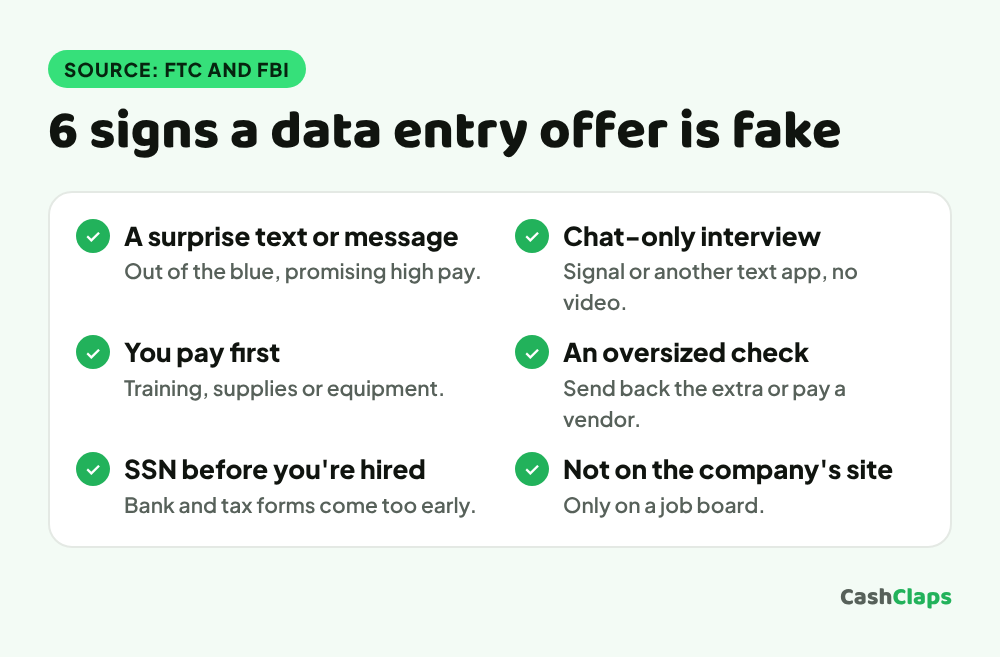
The interview happens only in a chat app
In its November 2023 alert, the FTC specifically called out listings for "a data entry clerk with great benefits and pay" where the so-called employer only wants to interview you on Signal Messenger or similar text-only apps. The same alert says scammers impersonate real companies on big platforms like ZipRecruiter and Indeed, so seeing the post on a well-known job board doesn't settle anything.
The FBI's Internet Crime Complaint Center adds a few more tells: interviews that aren't held in person or on a secure video call, recruiters writing from a non-company email domain, and recruiters with no profile on the job board (or one that doesn't fit the role).
A real interviewer will happily get on a video call. If they won't, you have your answer.
They want money from you first
Every version of this ends with you paying. Sometimes it's upfront for a background check or for training and supplies. Sometimes it's dressed up as equipment. The FTC described fake recruiters sending an invoice for a computer and asking the new hire to pay it with cash or through Zelle or PayPal, with a promise of reimbursement that never comes.
The FTC's side hustle alert from February 2026 is blunt about it: no legitimate gig will make you pay for expenses or training, or anything else to get the job. The FBI says victims of these fake hiring schemes lost nearly $3,000 each on average, plus the damage to their credit scores.
This isn't new either. Back in 2003, the FTC banned a Florida couple from selling "work-at-home data entry job opportunities" for $59 to $150. Their ads claimed incomes like $187.50 per day. Buyers got nothing.
The equipment check that's too big
Here's the part that catches careful people. The FTC's 2022 work-from-home alert describes fake data processing employers mailing a check to "buy equipment" that's for more than the amount needed, then asking you to send the leftover back to the company or to someone else.
The money shows up in your account, so it feels safe. It isn't. The FTC's fake check guide says that seeing the funds doesn't mean the check is good, and fake checks can take weeks to be discovered. When it bounces, the money you already forwarded is gone, and you can be left covering it.

Sign up for SoFi's free credit score monitoring as your first SoFi product and get $10 in SoFi rewards points, plus entries in SoFi's $50…
So the rule is simple. Never use money from an employer's check to send gift cards, crypto, a wire or a payment to anyone.
They ask for your Social Security number too early
A real employer does need your Social Security number and bank details, just after you're hired. The FBI says legitimate companies ask for that information for payroll after hiring, and that you should never give a credit card number to an employer at all.
Fake data entry jobs flip the order. The FTC says scammers ask you to fill out direct deposit and tax forms with your bank account and other personal information as part of the "hiring", sometimes right after a long chat interview. If a company asks for sensitive info before it hires you, the FTC's advice is to treat it as fake.
Pay that sounds too good for typing
Data entry is simple, repetitive work, so offers promising "fast cash" for "minimal work" deserve a second look. The FTC's job scams page says claims that you can make a lot of money in a short time with little work are almost certainly a scam. Pressure is the other tell: if someone says the spot disappears unless you accept right now, the FTC says to walk away.
How to check a data entry job in five minutes
Good news: checking is quick and free.
- Search the company name by itself and go to its own website. Find the careers page and make sure the data entry role is listed there. The FBI flagged jobs that appear on job boards but not on the company's site.
- Search the company, recruiter email and phone number with words like "review" or "complaint".
- Call the company using a number you found yourself, not one the recruiter gave you.
- Ask current or past workers what the job is like and whether they paid anything out of pocket, as the FTC suggests.
Then look for data entry and other remote work through sources that check listings. The FTC suggests starting with your state's CareerOneStop office. Our work from home page lists gigs we've looked into, and the six-point check in our guide to spotting fake remote job offers works for any role, data entry included. If you'd rather pay for a screened job board, we broke down what FlexJobs costs and who it suits.
If you already shared your details
Most of the cleanup is free and takes an evening.
Start with monitoring so you see trouble early. SoFi's free credit score monitoring gives you weekly score updates and alerts you to potential unauthorized activity or identity theft. New SoFi members who sign up through our listing also get a rewards points bonus (the offer box on this page shows the current amount).
If you sent money, call your bank or the app you paid with right away and ask them to stop or reverse it. If your Social Security number is out there, go to IdentityTheft.gov for a step-by-step recovery plan. And report the fake job at ReportFraud.ftc.gov, plus to the job board where you saw it.
Honestly, the habit that helps most is the dull one: never move money for an employer you haven't met on video. Set up credit monitoring before you start applying, and the rest of your job search gets a lot less stressful.
Frequently asked questions
Is data entry from home legit?
It can be. Real data entry jobs exist, but the FTC says fake recruiters often use data entry and reshipping gigs as bait. A real one will never ask you to pay for training, software or equipment.
Why would a remote job send me a check for equipment?
In the version the FTC describes, the check is fake and written for more than you need, and you're asked to send the extra back. The check bounces, and the money you sent is gone.
Can a data entry job interview happen over text?
The FTC flagged fake employers who only interview through Signal or similar text-only apps. A real employer will talk to you by phone or video.
When should a job ask for my Social Security number?
After you're hired, for payroll and tax forms. The FBI says legitimate companies collect that information after hiring, never during the application.
Where do I report a fake data entry job?
Report it to the FTC at ReportFraud.ftc.gov and to the website where you found the listing. The FBI also takes reports at ic3.gov.
Sources (9)
- FTC: Searching for a job to work remotely? Avoid scams and identity theft
- FTC: Want to work from home? Spot the scams first
- FTC: How to avoid a side hustle scam
- FTC: Scammers impersonate well-known companies on job platforms
- FTC: Job scams
- FTC: How to spot, avoid and report fake check scams
- FTC: Florida couple banned from selling work-at-home business opportunities
- FBI IC3: Cyber criminals use fake job listings
- SoFi: Free credit score monitoring
Sign up for SoFi's free credit score monitoring as your first SoFi product and get $10 in SoFi rewards points, plus entries in SoFi's $50…